
 Kento-kun
In this memo, we explain key building laws that are frequently used when designing wooden houses and small-scale buildings in Japan.
 Kento-kun
Let’s keep studying today!
Today, let’s learn about the system that allows some building confirmation documents to be omitted when the design has been prepared by an architect.
Today’s basic design memo for wooden houses is about the documents submitted for building confirmation.
In Japan’s building confirmation system, there is a special rule that allows part of the review and some submitted documents to be omitted when a Category 3 building is designed by an architect. This is provided under Article 6-4 of the Building Standards Act, “Special Rules regarding Confirmation of Construction.”
This system is useful because, under the law, it applies to certain buildings when they are designed by an architect.
 Kento-kun
The basic idea behind this system is that, when a building is designed by a licensed architect, the architect’s professional responsibility helps ensure compliance with the minimum standards required by law. Therefore, by allowing part of the review and some submitted design documents to be omitted, the system reduces the burden on both architects and reviewers and helps speed up the process from submission to the issuance of the confirmation certificate.
 Kento-kun
What types of buildings are covered by this special provision?
Kento-kunThe following three types of buildings are covered:
1.Buildings using materials certified under the type-certified building component manufacturer system
2.Buildings certified as conforming to an approved type
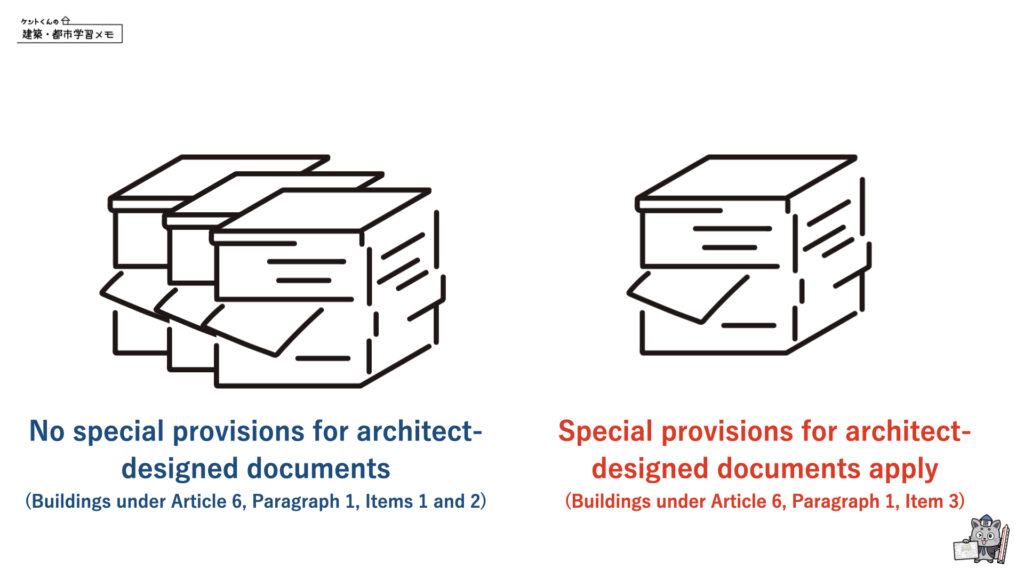
3.Buildings under Article 6, Paragraph 1, Item 3 of the Building Standard Act that are designed by an architect
The main focus of this memo is Category 3 buildings, which are single-story buildings with a floor area of 200 m² or less. In other words, these are small-scale buildings.
Kento-kunWhat kinds of documents do not need to be submitted?
Kento-kunThe scope of omitted review differs between detached houses located outside fire prevention districts and quasi-fire prevention districts, and other types of buildings.
In the table, “review omitted” means that the building official or similar reviewer does not review that particular provision. However, this does not mean that the building is allowed to ignore that provision.
Even if a provision is subject to omitted review, the designer must still confirm that the building complies with the Building
| Legal provision | Overview | (1) Detached houses located outside fire prevention districts and quasi-fire prevention districts(*) Ordinance Article 10, Item 3 | (2) Buildings other than (1)Ordinance Article 10, Item 4 |
|---|---|---|---|
| Article 20, Paragraph 1, Item 4(a) | Structural provisions | ⭕ | ⭕ |
| Article 21 | Large-scale wooden buildings・Four or more stories, excluding basement floors・Height over 16 m・Warehouses, automobile garages, etc. with a height of 13 m or more | ⭕ | ⭕ |
| Article 22 | Roof structure | ⭕ | ❌ |
| Article 23 | Exterior walls in parts exposed to potential fire spread | ⭕ | ❌ |
| Article 24 | Measures where a building extends across an Article 22 area | ⭕ | ❌ |
| Article 25 | Exterior walls and eaves of large-scale wooden buildings of 1,000 m² or more | ⭕ | ❌ |
| Article 27 | Special buildings required to be fire-resistant buildings, etc. | ⭕ | ❌ |
| Article 28, Paragraph 1 | Natural lighting for habitable rooms | ⭕ | ⭕ |
| Article 28, Paragraph 2 | Ventilation for habitable rooms | ⭕ | ⭕ |
| Article 28, Paragraph 3 | Ventilation equipment for rooms using combustion appliances | ⭕ | ❌ |
| Article 29 | Damp-proofing measures, etc. for habitable rooms in basements used as dwellings | ⭕ | ⭕ |
| Article 30 | Partition walls between row houses and apartment houses | — | ⭕ |
| Article 31, Paragraph 1 | Flush toilets in sewerage areas | ⭕ | ⭕ |
| Article 32 | Electrical equipment of buildings | ⭕ | ⭕ |
| Article 33 | Lightning protection equipment of buildings | ⭕ | ⭕ |
| Article 35 | Fire safety and evacuation provisions for special buildings, etc.・Buildings with three or more stories・Buildings without windows・Buildings over 1,000 m² | ⭕ | ❌ |
| Article 35-2 | Interior finish restrictions for special buildings, etc.・Buildings with three or more stories・Buildings without windows・Buildings over 1,000 m² | ⭕ | ❌ |
| Article 35-3 | Main structural parts of buildings without windows | ⭕ | ❌ |
| Article 37 | Quality of building materials | ⭕ | ⭕ |
| Enforcement Order Article 19 | Natural lighting for habitable rooms | ⭕ | ⭕ |
| Enforcement Order Article 20 | Calculation method for effective lighting area of habitable rooms | ⭕ | ⭕ |
| Enforcement Order Article 20-2 | Technical standards for ventilation equipment | ⭕ | ⭕ |
| Enforcement Order Article 20-3 | Ventilation equipment, etc. for rooms using combustion appliances | ⭕ | ❌ |
| Enforcement Order Article 21 | Ceiling height of habitable rooms | ⭕ | ⭕ |
| Enforcement Order Article 22 | Floor height and damp-proofing method of habitable rooms | ⭕ | ⭕ |
| Enforcement Order Article 22-2 | Technical standards for habitable rooms in basements used as dwellings | ⭕ | ⭕ |
| Enforcement Order Article 22-3 | Partition walls between row houses and apartment houses: sound insulation | ⭕ | ⭕ |
| Enforcement Order Article 23 | Stairs | ⭕ | ⭕ |
| Enforcement Order Article 24 | Landings | ⭕ | ⭕ |
| Enforcement Order Article 25 | Handrails for stairs, etc. | ⭕ | ⭕ |
| Enforcement Order Article 26 | Ramps used instead of stairs | ⭕ | ⭕ |
| Enforcement Order Article 27 | Stairs exclusively used for special purposes | ⭕ | ⭕ |
| Enforcement Order Article 28 | Toilets | ⭕ | ⭕ |
| Enforcement Order Article 29 | Pit toilets | ⭕ | ⭕ |
| Enforcement Order Article 30 | Toilets in special buildings | ⭕ | ⭕ |
| Enforcement Order Article 31 | Improved septic tanks | ⭕ | ⭕ |
| Enforcement Order Article 33 | Leakage inspection | ⭕ | ⭕ |
| Enforcement Order Article 34 | Distance between toilets and wells | ⭕ | ⭕ |
| Enforcement Order Articles 36 to 80-3 | Supplementary provisions concerning building structures and structural methods; structures in Sediment Disaster Special Warning Areas | ⭕ | ⭕ |
| Enforcement Order Articles 107 to 128-6 | Technical standards for fire performance, corridors, evacuation stairs, exits, etc. | ⭕ | ❌Only Article 119, corridor width, is subject to omitted review |
| Enforcement Order Articles 129-2-3 to 129-2-6 | Building equipment, excluding elevators | ⭕ | ⭕The following provisions remain subject to review:・Article 129-2-4, Paragraph 1, Item 6: structure of ventilation ducts for basements, etc.・Article 129-2-4, Paragraph 1, Item 7: treatment of penetrations through fire compartments, etc. |
| Enforcement Order Articles 129-14 to 129-15 | Structure of lightning protection equipment | ⭕ | ⭕ |
| Enforcement Order Article 144-3 | Quality of building materials for parts important for safety, fire prevention, and sanitation | ⭕ | ⭕ |
| Article 39 | Buildings in disaster hazard areas | ⭕ | ⭕ |
| Article 40 | Strengthening of restrictions by local government ordinances | ⭕ | ⭕ |
| Article 41 | Relaxation of restrictions by local government ordinances | ⭕ | ⭕ |
⭕: Subject to omitted review
Kento-kunSo, does this mean that the parts subject to omitted review do not need to be described in the drawings, or that some drawings do not need to be submitted?
Kento-kunThat’s right. For example, in relation to the structural provisions under Article 20, if the building complies with the prescriptive structural provisions and does not require structural calculation, the submission of structural drawings may be omitted.
Kento-kunBut even if the review is omitted, that does not mean the drawings themselves do not need to be prepared, right?
Kento-kunExactly. The Architects Act includes provisions concerning design documents. In addition, construction work itself cannot proceed smoothly unless these drawings and documents are properly prepared.
Kento-kunWhat is the difference between Order Article 10, Item 3 and Item 4?
Kento-kunOrder Article 10, Item 3 applies to detached houses located outside fire prevention districts and quasi-fire prevention districts among buildings under Article 6, Paragraph 1, Item 3 of the Building Standards Act.
Order Article 10, Item 4 applies to buildings under Article 6, Paragraph 1, Item 3 other than those covered by Item 3.
In other words, both are Category 3 buildings under Article 6, Paragraph 1, Item 3, but the scope of provisions subject to omitted review differs.
The main point to note is that, compared with Item 3 detached houses, Item 4 buildings may still be subject to review for certain fire safety and evacuation provisions, as well as ventilation equipment for rooms using combustion appliances, such as kitchens or cooking rooms.
コメント