
 Kento-kun
In this memo, we will look at one simple but surprisingly difficult question:
Where does Tokyo begin and end?
When people say “Tokyo,” they are not always talking about the same area.
Sometimes they mean Tokyo Metropolis as an administrative area. Sometimes they mean the 23 wards at the center of Tokyo. In other cases, they may be referring to the Tokyo metropolitan area, Greater Tokyo, or even the large urban area shown in international statistics.
 Kento-kun
In other words, Tokyo does not have just one boundary.
The meaning of “Tokyo” changes depending on what you want to understand.
Kento-kunBy reading this memo, you will be able to understand what “Tokyo” often means in international contexts, and how terms such as Tokyo Metropolis, the 23 wards, the Tokyo Area, and Greater Tokyo differ from one another.
Memo 1: Tokyo as an Urban Agglomeration of About 33.41 Million People
 Kento-kun
First, let’s look at Tokyo from a global perspective.
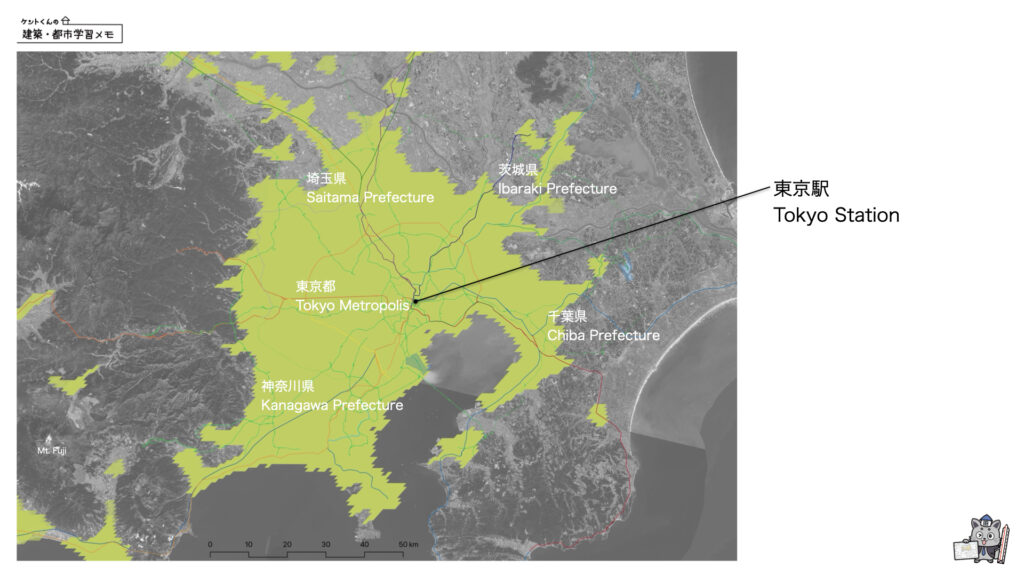
In the United Nations’ World Urbanization Prospects 2025, Tokyo is shown as an urban agglomeration with a population of about 33.41 million in 2025.
 Kento-kun
Many people have heard that “Tokyo is a city of more than 30 million people.”
But you may have wondered where that number comes from.
The United Nations publishes data and projections on urban populations around the world. In that data, Tokyo is treated as an urban agglomeration for international comparison.
The important point is this:
The “Tokyo” shown by the United Nations is not the same as the administrative area of Tokyo Metropolis.
Instead, it refers to a much wider urban area centered on Tokyo, where built-up urban land extends continuously across administrative boundaries.
In English, this kind of urban area is called an urban agglomeration. In Japanese, it is often translated as 都市的集積 or 都市集積.
Under this definition, Tokyo extends beyond Tokyo Metropolis. It includes not only Tokyo itself, but also surrounding urbanized areas in Saitama Prefecture, Chiba Prefecture, Kanagawa Prefecture, and even parts of Ibaraki Prefecture.
This area is much larger than Tokyo Metropolis as an administrative unit.
So, when people overseas say that “Tokyo is one of the world’s largest cities,” they are often not talking only about Tokyo Metropolis. They are referring to the large urban agglomeration that has developed around Tokyo.
However, this United Nations definition also needs to be understood carefully.
The UN definition is useful because it allows cities around the world to be compared using a common framework. But it does not perfectly match Japanese urban planning systems or the everyday sense of how people experience Tokyo.
It mainly captures Tokyo through the continuity of built-up areas and population concentration. It does not directly show where people work, how strongly surrounding municipalities are connected to Tokyo’s employment, or how daily life is connected to the central city.
In that sense, the UN-defined Tokyo urban agglomeration is very useful for understanding Tokyo as seen from the world, but it does not explain everything about the actual structure of the Tokyo metropolitan region.
Memo 2: Tokyo Metropolis
 Kento-kun
Next, let’s look at Tokyo Metropolis.
When people outside Japan look at Tokyo, they may assume that Tokyo Metropolis is simply “Tokyo.” However, Tokyo Metropolis is an administrative unit within Japan’s local government system.
In Japan, local government is generally organized into prefectures as wide-area local governments, and municipalitiessuch as cities, towns, villages, and special wards as basic local governments.
Tokyo Metropolis is one of these wide-area local governments.
In that sense, Tokyo Metropolis is Tokyo as an administrative area.
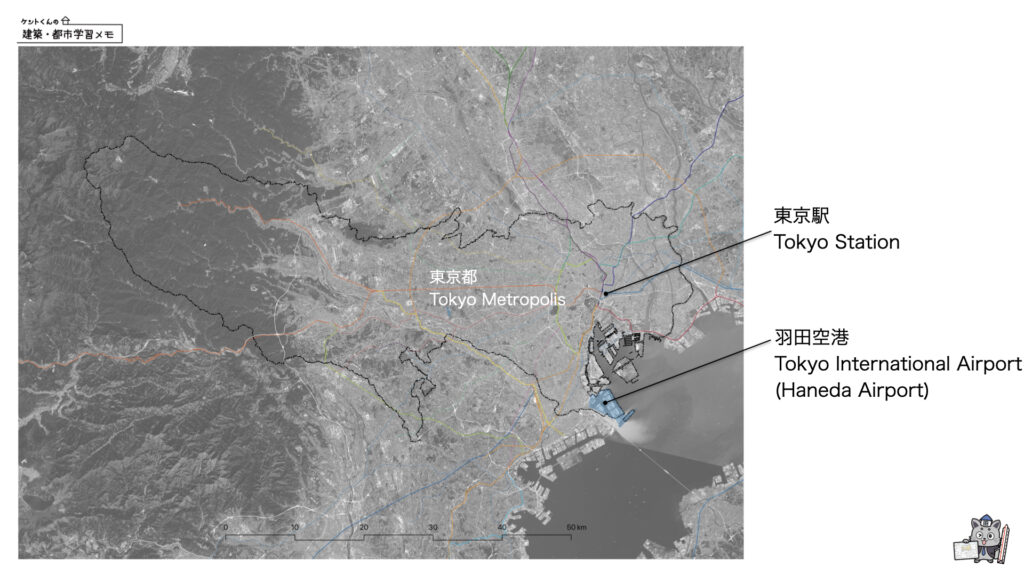
However, Tokyo Metropolis does not consist only of dense central urban districts.
The western part of Tokyo Metropolis includes mountainous areas such as Okutama and Hinohara. These areas are rich in nature and are located near the borders with Yamanashi Prefecture and Saitama Prefecture.
So, if you look at a map of Tokyo Metropolis, you can see that it includes not only central urban districts but also large mountainous areas to the west.
These western areas have lower population density than central Tokyo, and in some places their employment relationship with central Tokyo is relatively weaker. At the same time, they play important roles in nature conservation, tourism, forests, and water resources.
In other words, Tokyo Metropolis certainly includes Japan’s central urban functions. But the area of Tokyo Metropolis is not the same as the entire Tokyo metropolitan region. It is, first of all, an administrative area.
As a side note, western Tokyo also has many places where visitors can enjoy nature, such as the valleys and limestone caves of Okutama and Mount Takao. This also shows that Tokyo Metropolis is not only a dense central city.
 Kento-kun
The population of Tokyo Metropolis has recently been around 14 million.
That is still very large, but it is less than half of the approximately 33.41 million people shown in the UN’s Tokyo urban agglomeration.
This makes it clear that Tokyo cannot be fully understood by looking only at Tokyo Metropolis.
Memo 3: Tokyo’s 23 Wards
 Kento-kun
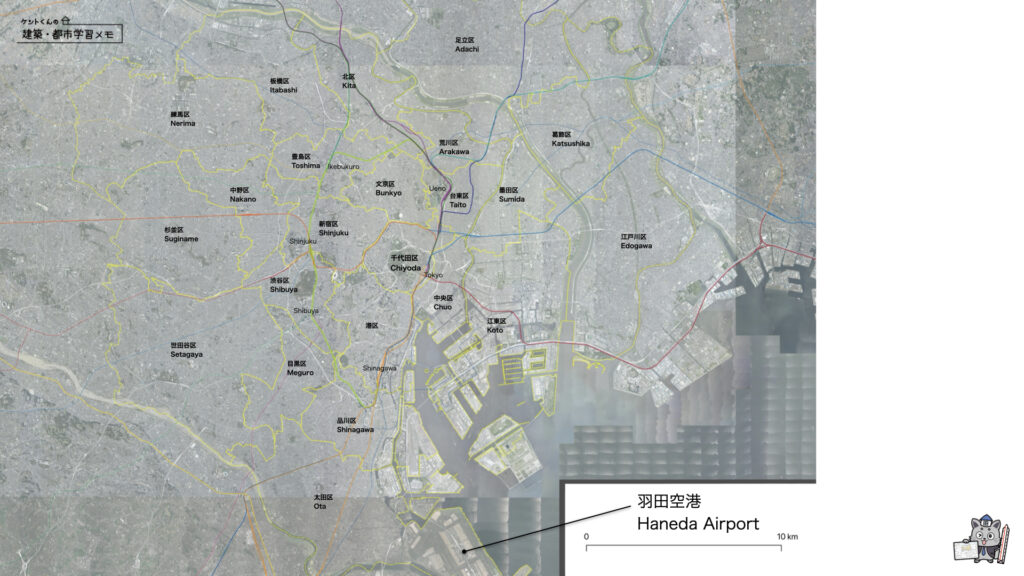
Next, let’s look at Tokyo’s 23 wards.
Tokyo’s 23 wards are special wards. Historically, they developed from the area of the former Tokyo City.
Tokyo has a unique type of basic local government found only in Tokyo: the special ward. These are the 23 wards of Tokyo.
Other large Japanese cities, such as Osaka, Nagoya, and Sendai, also have “wards.” However, those wards are different from Tokyo’s 23 wards in terms of their legal and administrative status.
In government-designated cities outside Tokyo, wards are closer to internal administrative units of the city government. They do not have the same level of independence as municipalities, and they do not have directly elected mayors or assemblies in the same way.
By contrast, Tokyo’s 23 wards have powers similar to municipalities. They have ward assemblies and ward mayors, and they function as special basic local governments.
However, it is important not to assume that Tokyo’s 23 wards alone are the entire area of Tokyo.
It is true that many parts of the 23 wards inherited historical urban areas that developed from the Edo period and the former Tokyo City. Areas such as Chiyoda City, Chuo City, Minato City, Taito City, Bunkyo City, the southern part of Sumida City, and the western part of Koto City are closely connected to the historical formation of Edo and Tokyo.
However, Tokyo’s modern urban region extends far beyond the 23 wards.
Employment, housing areas, and built-up urban land spread widely outside the wards.
So, the 23 wards are certainly the central part of Tokyo, but they do not represent the whole Tokyo metropolitan region.
The relationship between Edo-period urban areas and today’s wards can be roughly summarized as follows.
| Ward / Area | Historical Character |
|---|---|
| Chiyoda City | Edo Castle, daimyo residences, and the center of samurai districts |
| Chuo City | Nihonbashi and Kyobashi, merchant districts and commercial center |
| Minato City | Shiba, Azabu, Akasaka, samurai districts, temples, and shrines |
| Eastern Shinjuku City | Yotsuya and Ushigome, samurai districts, temples, and shrines |
| Bunkyo City | Koishikawa and Hongo, samurai districts, temples, and shrines |
| Taito City | Asakusa, Ueno, and Shitaya, merchant areas, temples, and shrines |
| Southern Sumida City | Honjo, urban areas that developed especially in the later Edo period |
| Western Koto City | Fukagawa, merchant areas, water transport, and reclaimed land |
The former 15 wards of Tokyo City, established in the Meiji era, largely inherited the central urban area that had developed since the Edo period. Later, in 1932, surrounding towns and villages were incorporated into Tokyo City, and Tokyo City expanded to 35 wards. After the war, those 35 wards were reorganized into the current 23 wards.
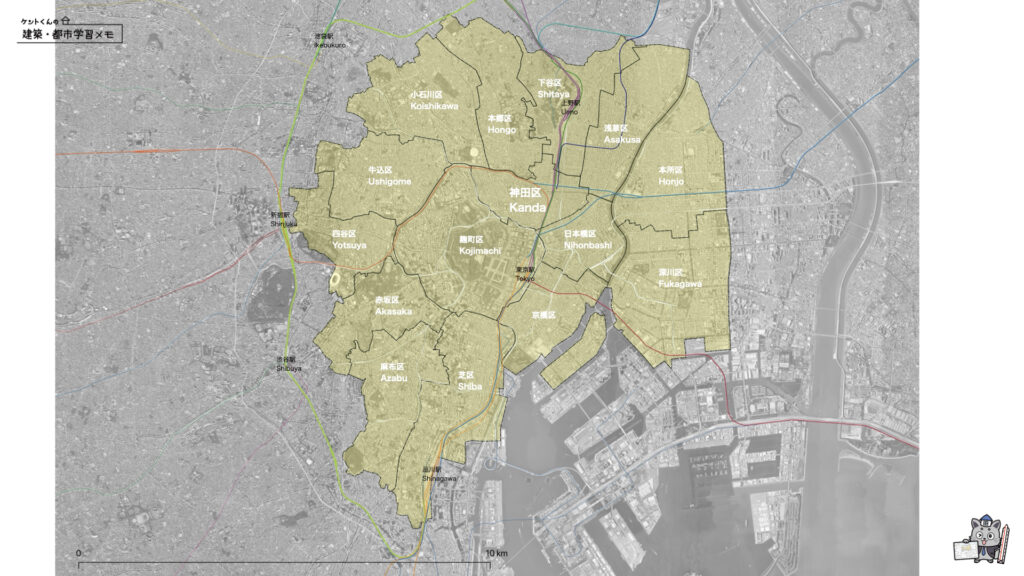
In other words, today’s 23 wards are not exactly the same as the Edo-period city itself. They are an expanded urban area formed around the historical core of Edo and Tokyo, shaped by modern suburbanization and administrative expansion.
Kento-kunThe population of Tokyo’s 23 wards has recently been around 10 million.
That is an extremely large urban population, but it is still only part of the wider Tokyo metropolitan region.
Memo 4: Tokyo Area as One Metropolis and Three Prefectures
 Kento-kun
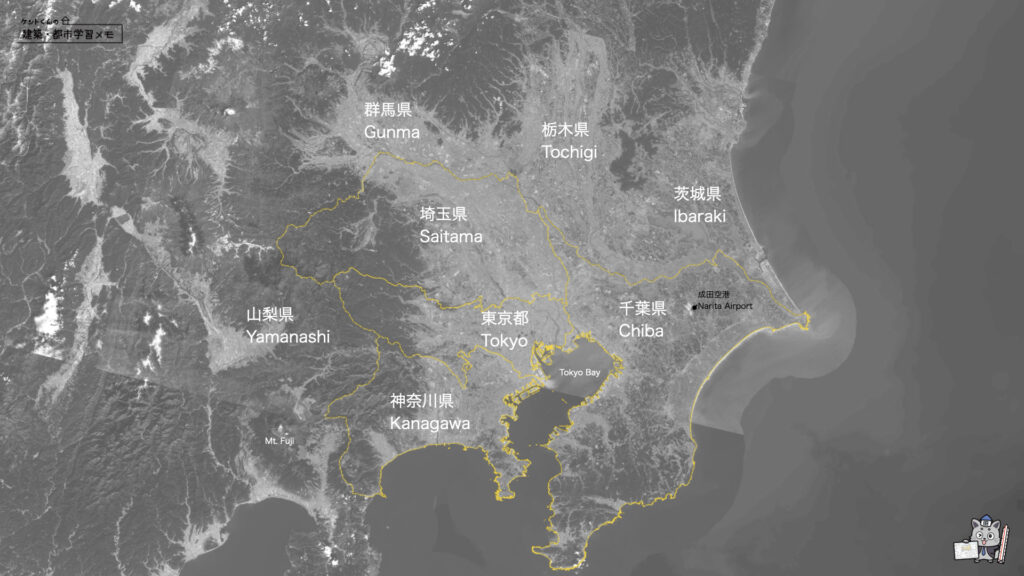
Next, let’s look at the area often called the Tokyo Area in Japanese policy and statistics.
In Japan, the term one metropolis and three prefectures refers to the area consisting of:
- Tokyo Metropolis
- Saitama Prefecture
- Chiba Prefecture
- Kanagawa Prefecture
In Japanese government documents and statistics, this area is often used as a practical definition of the Tokyo Area.
This definition is easy to understand.
Tokyo Metropolis is surrounded by Saitama, Chiba, and Kanagawa, and these areas are strongly connected by railways and roads. Many people commute from these prefectures toward central Tokyo.
It is also convenient for statistical analysis because data can be aggregated by prefecture. For that reason, national government documents, private statistical reports, and some consulting materials often use one metropolis and three prefectures when discussing population movement, wide-area administration, or the concentration of people and functions in Tokyo.
However, the area of one metropolis and three prefectures does not perfectly represent Tokyo as a functional urban region.
This is because some areas within the four prefectures have relatively weak connections with central Tokyo. For example, southern parts of the Boso Peninsula in Chiba Prefecture, the Choshi area, mountainous areas in western Kanagawa Prefecture, and Okutama in Tokyo Metropolis are all included administratively in one metropolis and three prefectures. But their relationship with employment and daily urban activity in central Tokyo is very different from that of inner suburban areas.
On the other hand, some areas outside the four prefectures, such as parts of southern Ibaraki Prefecture, may have stronger employment connections with Tokyo than some outer areas within the four prefectures.
In other words, one metropolis and three prefectures is a convenient statistical area, but it does not directly show the social and economic reality of Tokyo as a functional urban region.
Using one metropolis and three prefectures as the Tokyo Area is not wrong.
However, it should be understood as an administrative and statistical convenience, not as a perfect description of the actual urban region.
Kento-kunThe population of one metropolis and three prefectures was about 36.91 million in the 2020 national census, and is now roughly in the 37 million range. This is larger than the UN-defined Tokyo urban agglomeration population of about 33.41 million.So, one metropolis and three prefectures is an easy-to-understand way to think about the Tokyo Area, but it may also be slightly too broad in some respects.
Memo 5: The Tokyo Metropolitan Area as an Urban Employment Area
 Kento-kun
Finally, let’s look at Tokyo through employment connections.
This is a very important perspective for understanding Tokyo as a functional urban region.
An urban region is not determined only by administrative boundaries. It can also be understood as the area where a central city and surrounding municipalities are socially and economically connected.
One of the most important ways to measure that connection is employment.
Where do people live, and where do they work?
By looking at daily commuting patterns, we can see the outline of an urban region that cannot be understood from administrative boundaries alone.
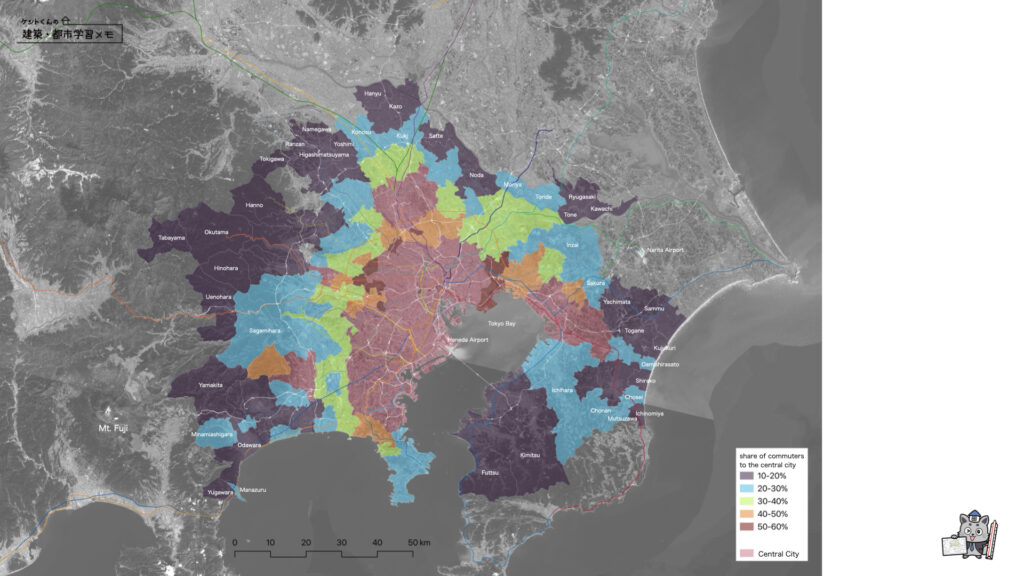
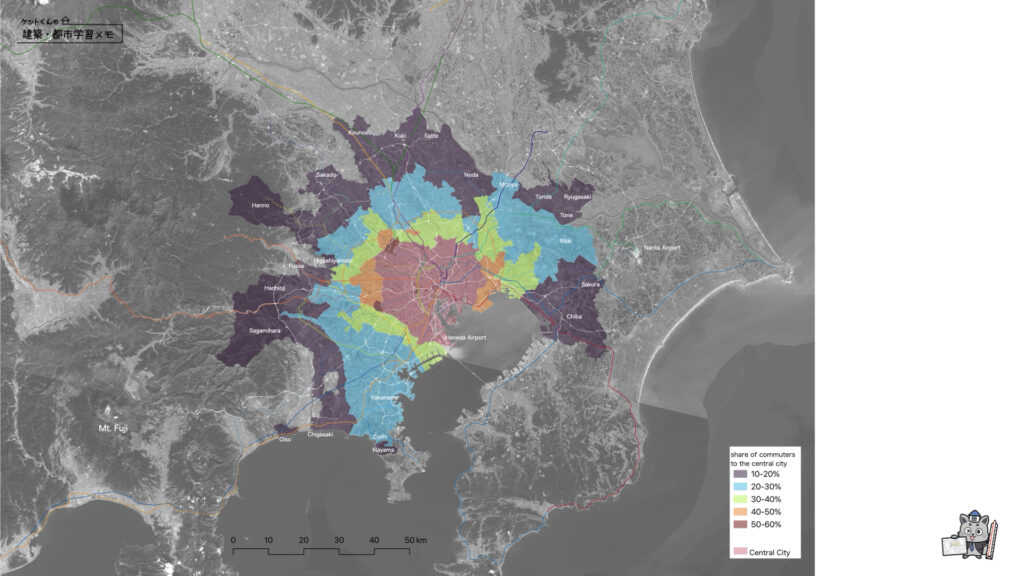
In the concept of an Urban Employment Area, the relationship between a central city and surrounding municipalities is measured by the share of residents commuting to the central city. Municipalities with a sufficiently strong commuting relationship to the central city are treated as suburbs of that central city.
However, Tokyo is more complex than a simple urban region centered only on the 23 wards.
Inside the Tokyo metropolitan region, there are also important subcenters that attract workers from surrounding areas, such as Yokohama, Kawasaki, Chiba, Saitama, Tachikawa, and Atsugi.
For this reason, Tokyo should not be understood as a monocentric urban region with only one center. It should be understood as a polycentric metropolitan region with multiple centers.
When viewed as an Urban Employment Area, Tokyo is not just Tokyo Metropolis.
It is also not simply the area of one metropolis and three prefectures painted on a map.
Instead, it is a huge urban region centered on the 23 wards, while also including subcenters such as Yokohama, Kawasaki, Chiba, Saitama, Tachikawa, and Atsugi. Its boundary appears through employment connections.
This perspective shows that the boundary of the Tokyo metropolitan area is not determined by prefectural borders. It appears through where people work and how daily life is connected to employment.
For example, northwestern Chiba Prefecture, southern Saitama Prefecture, and eastern Kanagawa Prefecture have strong employment connections with central Tokyo. On the other hand, even within one metropolis and three prefectures, southern parts of the Boso Peninsula and mountainous areas have weaker connections with central Tokyo.
There are also areas outside one metropolis and three prefectures, such as parts of southern Ibaraki Prefecture, where employment connections with Tokyo can still be seen.
In other words, the Tokyo metropolitan area is not simply a group of addresses.
It is a wide-area urban region that appears through the extent to which people’s daily lives are connected to Tokyo’s employment.
At the same time, it is also important to note that an Urban Employment Area does not explain everything about Tokyo. People’s lives also include shopping, education, medical care, weekend travel, and local community relationships. An Urban Employment Area does not directly capture all of these elements.
Even so, employment connections are extremely important for understanding the Tokyo metropolitan region. This is because the spread of residential areas, built-up urban land, and railway networks in the Tokyo region is deeply related to how far people’s lives are connected to Tokyo’s employment.
From Kento-kun’s perspective, if we look only at the 23 wards as the central city and examine direct employment connections to the 23 wards, we can get closer to the commonly imagined area of the Tokyo metropolitan region.
In that case, the population was about 32.20 million in 2020. This is slightly smaller than the UN-defined Tokyo urban agglomeration population of about 33.41 million, but it can be understood as an area that more directly shows the centrality of Tokyo’s 23 wards.
 Kento-kun
When we look at Tokyo through employment, we can see a different area from Tokyo Metropolis or one metropolis and three prefectures.This is very important for understanding Tokyo as a metropolitan region.
Summary
Kento-kunLet’s review the different meanings of Tokyo.
Tokyo does not have just one boundary.
The area of Tokyo changes depending on which definition you use.
| Perspective | Meaning of the Area |
|---|---|
| Tokyo Metropolis | Tokyo as an administrative area |
| Tokyo’s 23 Wards | The central part of Tokyo and its special wards |
| One Metropolis and Three Prefectures | A policy and statistical definition of the Tokyo Area |
| UN-defined Tokyo | Tokyo urban agglomeration for international comparison |
| Urban Employment Area | A functional Tokyo metropolitan region connected through employment |
Tokyo Metropolis is Tokyo as an administrative area.
The 23 wards are the central part of Tokyo, both historically and today.
One metropolis and three prefectures is a convenient wide-area definition often used in policy and statistics.
The UN-defined Tokyo is a huge urban agglomeration seen from a global perspective.
The Urban Employment Area shows a functional metropolitan region connected socially and economically through employment.
None of these definitions is the only correct one.What matters is that the definition of “Tokyo” changes depending on what you want to understand.
 Kento-kun
In short, Tokyo cannot be enclosed by a single line.
Multiple versions of Tokyo overlap with one another, and together they form the huge metropolitan region that we casually call “Tokyo.”
Tokyo’s boundary is not determined only by prefectural borders.
コメント