
 Kento-kun
This memo provides a clear summary of the laws frequently used in the design of new wooden houses and small-scale buildings.
 Kento-kun
I’ve got to study hard again today!
Today, let’s learn about the relationship between wooden buildings and the building categories that require confirmation applications.
Today’s basic topic in wooden house design is the relationship between wooden buildings and the categories for building confirmation applications. More specifically, we will look at each item of Article 6, Paragraph 1 of Japan’s Building Standard Law and learn which category a wooden building falls under.
This is very important because the category under Article 6, Paragraph 1 affects whether a building confirmation application is required, the statutory review period for the confirmation process, and whether certain review documents may be omitted at the time of the confirmation application and completion inspection. In this memo, I focus on wooden houses and small-scale wooden buildings.
 Kento-kun
First, let’s look at the categories under Article 6, Paragraph 1 of the Law.
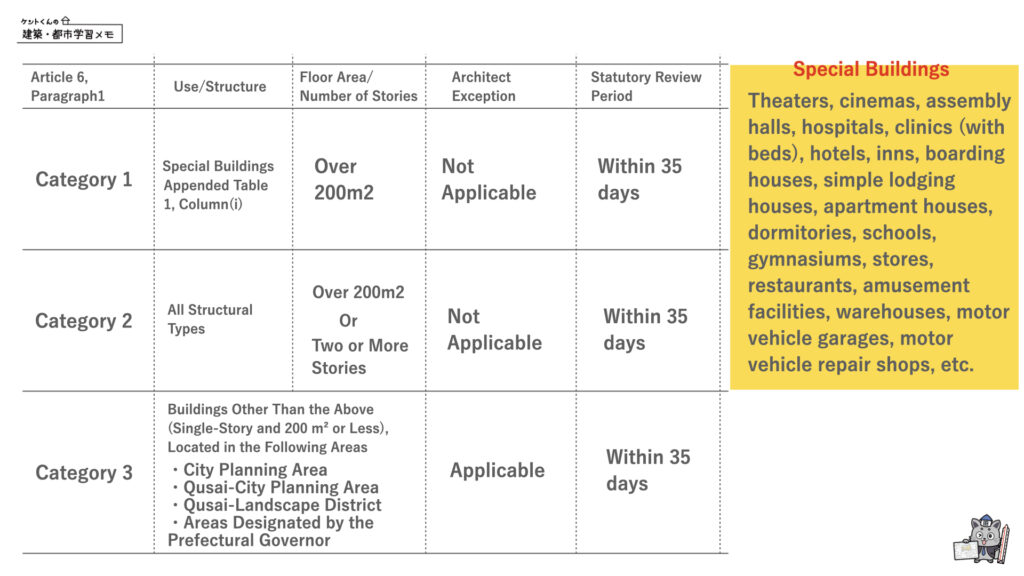
Under the current law, buildings are divided into three categories: Category 1, Category 2, and Category 3.
・ Category 1: Special buildings
・ Category 2: Medium-scale or larger buildings
・ Category 3: Small-scale buildings
Kento-kunSo, the categories are not based on the structural system, but rather on three factors: building use, floor area, and number of stories.
Category 1 refers to special buildings, but not the special buildings defined at the beginning of the Law in the definitions section. Instead, it refers to the special buildings listed in Appended Table 1 of the Law. It applies to buildings in which the floor area of the portion used for a special building purpose exceeds 200 m².
Category 2 is determined by the number of stories and the total floor area. It applies to buildings with two or more stories and a total floor area exceeding 200 m². It uses total floor area, not just floor area, because total floor areameans the sum of the floor areas of all stories.
Category 3 refers to buildings that fall under neither Category 1 nor Category 2. In other words, it applies to buildings that are one story only and have a floor area of 200 m² or less.
 Kento-kun
Under the law, Categories 1 to 3 are defined simply by use, number of stories, and floor area, not by whether the building is of wooden construction or not. In fact, before the April 2025 amendment, there used to be a separate classification based on wooden construction, but the amendment simplified the rules into the current form.
 Kento-kun
For example, which category does a detached wooden house fall under?
Kento-kunA detached wooden house is a non-special building, so it does not fall under Category 1. Instead, it falls under Category 2 or Category 3. For example:
・Two-story detached wooden house → Category 2 building
・Single-story detached wooden house, 220 m² → Category 2 building
・Single-story detached wooden house, 120 m² → Category 3 building
Kento-kunThere is a statement in the Category 3 provision about urban planning areas and the Landscape Act. What does that mean?
Kento-kunIt means that the Category 3 provision applies only within the areas specified in Category 3. In other words, if a building is located in an area that does not fall under any of those designated areas, then it does not fall under Category 1, 2, or 3, and therefore a building confirmation application is not required.
・City Planning Area
・Quasi-City Planning Area
・Quasi-Landscape District
・Areas designated by the prefectural governor
Kento-kunI see. And only Category 3 buildings can use the architect exception, which allows some submission documents to be omitted when applying for building confirmation or for completion inspection. It also means that no building energy efficiency compliance review is required, right?
 Kento-kun
That is correct. However, please note that this applies only to buildings designed and supervised by a licensed architect. As an additional point, only Category 3 buildings have a shorter statutory review period of 7 days(Categories 1 and 2 are 35 days).
Incidentally, for wooden buildings, structural calculation (allowable stress design / Route 1) is required if the building has three or more stories or a total floor area exceeding 300 m². So, if you want to keep the structural design simple while also taking advantage of some review omissions available for architect-designed buildings, one possible strategy is to keep the building single-story and 200 m² or less.


コメント