
 Kento-kun
This memo provides a clear summary of the laws frequently used in the design of new wooden houses and small-scale buildings.
 Kento-kun
I’ve got to study hard again today!
Today, let’s learn about “areas exposed to fire spread.”
Today’s basic topic in wooden house design is “which wooden buildings must be at least quasi-fire-resistant.”
When designing wooden houses or small-scale wooden buildings, they are generally allowed to be classified as “other buildings,” meaning that they do not have to be fire-resistant buildings or quasi-fire-resistant buildings. However, even wooden houses and small-scale wooden buildings must be made quasi-fire-resistant—that is, buildings with greater protection against fire—if they fall under certain uses or are located in certain designated areas.
Today, I will summarize in this memo the cases in which wooden houses and small-scale wooden buildings fall under those specific uses or designated areas.
 Kento-kun
As a general rule, there are three key points to determine whether a small-scale wooden house or similar building must be at least quasi-fire-resistant. Among these, Point 3 is not included in this memo because it is rarely relevant in small-scale wooden design.
1. Use
2. Specific designated areas
3. Manufacture or storage of hazardous materials
Kento-kunOkay! Let’s learn about uses and specific designated areas.
First, let’s look at use.
You only need to remember two cases here.
The first case is when the third floor or above is used as a special building such as an assembly hall, hospital, clinic, hotel, inn, boarding house, apartment house, dormitory, restaurant, retail store, or school. In this case, as a general rule, the building must be either a fire-resistant building or a one-hour quasi-fire-resistant structure (the so-called “Wooden 3-Kyo,” which applies only to apartment houses and schools).
The second case is when the second floor is used as a hospital, clinic, hotel, inn, simple lodging, apartment house, or similar use, and the floor area of the second floor is 300 m² or more. In this case, the building must be at least a quasi-fire-resistant building.
 Kento-kun
If the building is classified as an apartment house, and the third floor is used as an office that is not directly related to the apartment use, does the building still need to be fire-resistant?
Kento-kunIn that case, if the third floor is used as an office that is not related to the apartment use, it does not fall under the category of a special building, so the building does not need to be made fire-resistant or the like. However, even if it is called an office, if it is actually part of the apartment use—for example, a management office for the apartment building—then it must be treated as part of the apartment house, and the building must be made fire-resistant.
Next, let’s look at specific designated areas.
These are related to Fire Prevention Districts and Quasi-Fire Prevention Districts.
First, Fire Prevention Districts. In a Fire Prevention District, buildings are generally required to be at least quasi-fire-resistant, except for accessory buildings with a total floor area of 50 m² or less. So, aside from small storage sheds, utility sheds, or garages attached to a detached house, buildings are generally required to be at least quasi-fire-resistant. Also, if the total floor area exceeds 100 m², the building must, as a general rule, be fire-resistant.
Next, in a Quasi-Fire Prevention District, a building is required to be at least quasi-fire-resistant if it has three or more stories or a total floor area exceeding 500 m².
Kento-kunI see. So, in other words, building a wooden structure in a Fire Prevention District requires fire protection measures close to those of a fire-resistant structure. That sounds difficult…
Kento-kunHere is the summary.
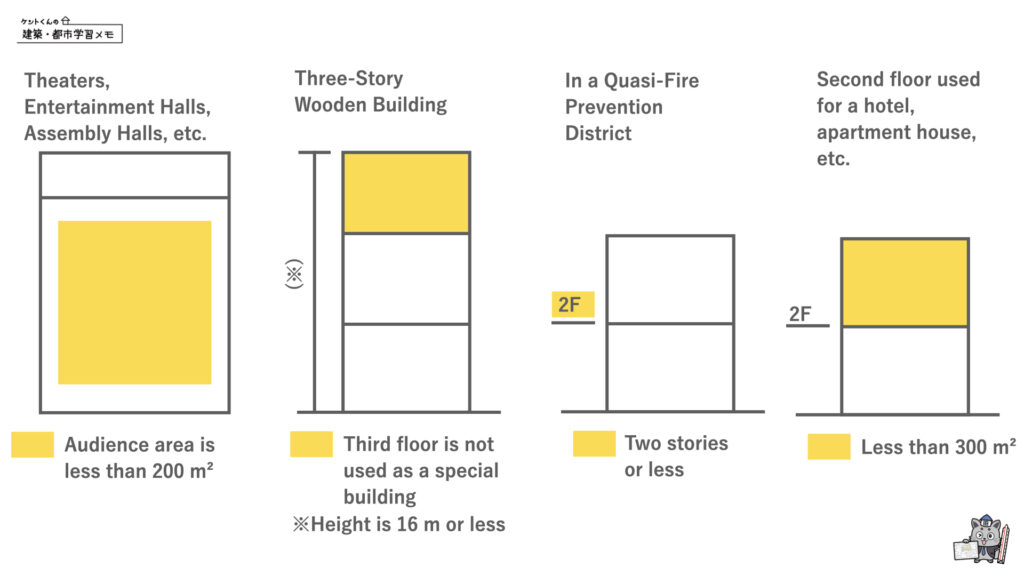
To add a few supplementary points, a small-scale wooden building does not need to be at least quasi-fire-resistantunless it falls under one of the following conditions:
・Keep the audience area of a theater, entertainment hall, or assembly hall to less than 200 m².
・Do not plan the third floor for use as a special building.
・The building is not located in a Fire Prevention District.
・In a Quasi-Fire Prevention District, do not make it three stories or more.
・Keep the height at 16 meters or less.
Kento-kunI see. So the key points are the following three:
・Do not use the third floor or above as a special building.
・Make sure the building is not located in a Fire Prevention District.
・If the second floor is used as a special building, such as an apartment house, keep its floor area below 300 m².
Finally, as a supplementary note, here are some specific examples of cases in which a detached house, row house, or office (each with a total floor area of 500 m² or less) must be made at least quasi-fire-resistant.
For a detached house or an office, the first things to check are whether it is located in a Fire Prevention District and whether it has three or more stories. If it is located in a Fire Prevention District, you should note that it must be made at least fire-resistant. Next, if the building has three or more stories, you need to check whether it is located in a Quasi-Fire Prevention District. If it is in a Quasi-Fire Prevention District and has three or more stories, it must be made quasi-fire-resistant.
If neither of these applies, and the building height is 16 meters or less (roughly equivalent to a 4- to 5-story building), then it is not required to be at least quasi-fire-resistant. Incidentally, a quasi-fire-resistant building (with 45 minutes of fire performance) is more expensive and requires more effort in construction, but it can still be designed if those requirements are met. In many densely built-up residential areas, Quasi-Fire Prevention Districts are often designated, so even on a small urban lot, a three-story house may need to be designed as a quasi-fire-resistant building.

コメント